


Table of Contents
- What Makes Framing Truly Archival in 2026
- Comparing the Best Archival Framing Services for Collectors
- Museum-Quality Framing Standards Explained
- UV Protection for Signed Historical Documents
- How to Safely Ship Expensive Collectibles to a Framer
- Environmental Impact and Long-Term Maintenance of Archival Frames
- Conclusion: Choosing the Right Archival Framing Service for Your Collection
- Frequently Asked Questions
Last Updated: October 2, 2026
What Makes Framing Truly Archival in 2026
Archival framing means mounting and enclosing a document or photograph with materials that will not damage it over decades of display. For collectors of signed historical documents, the difference between a decorative frame and a true archival build comes down to chemistry, not appearance.

Acid-free materials sit at the center of that distinction.
The Materials That Matter: Acid-Free, Lignin-Free, and Buffered
Four components decide whether a frame protects or harms its contents.
| Component | Archival Standard | Common Non-Archival Substitute |
|---|---|---|
| Mat board | Acid-free, lignin-free, buffered | Standard decorative board |
| Mounting | Hinge mounting, reversible | Dry mounting, adhesive |
| Glazing | UV-protective glass or acrylic | Plain glass |
| Frame depth | Rabbet fits full stack with spacer | Frame compresses artwork |
Comparing the Best Archival Framing Services for Collectors
Choosing a framing provider comes down to three models: a dedicated archival framing studio, a general custom frame shop, and DIY with archival supplies. Each has a clear best-fit buyer and a predictable failure mode.
A Vetting Checklist You Can Use on Any Provider
Before handing over a signed piece, run the provider through a short set of questions. The answers separate studios that understand preservation from shops that simply sell frames.
- "What board do you use, and is it buffered?" A preservation-literate shop will name the product and confirm it is acid-free, lignin-free, and buffered. A vague answer is a red flag.
- "How will you mount this?" The correct answer for a signed document is reversible hinge mounting with Japanese paper and wheat starch paste. If the answer is dry mounting or spray adhesive, walk away.
- "What glazing options do you stock?" Look for UV-filtering glass, museum glass with anti-reflective coating, and acrylic. A shop offering only plain glass is not set up for archival work.
- "Will you seal the back?" A dust cover keeps insects, dust, and moisture out of the frame package.
- "Can you show me the back of a finished piece?" A clean hinge mount, a sealed dust cover, and a materials label tell you more than any sales pitch.
- "Do you document the materials used?" A written record of board, glazing, and mounting method is useful for insurance and for any future conservator.
Matching the Provider to the Medium
- Signed photographs and paper documents are the most common archival framing job, needing buffered board, UV glazing, and reversible mounting. Most dedicated studios handle these routinely.
- Oil paintings should not be pressed against glazing or framed with a mat. They need adequate rabbet depth for air circulation, and cleaning or varnish work belongs with a conservator, not a framer.
- Textiles and fabric pieces require stitching to a backing rather than adhesion, with even support so their own weight does not distort them.
- Oversized or fragile pieces are where a general shop often struggles. Ask whether the studio has handled comparable sizes and will pick up and deliver rather than have you ship.
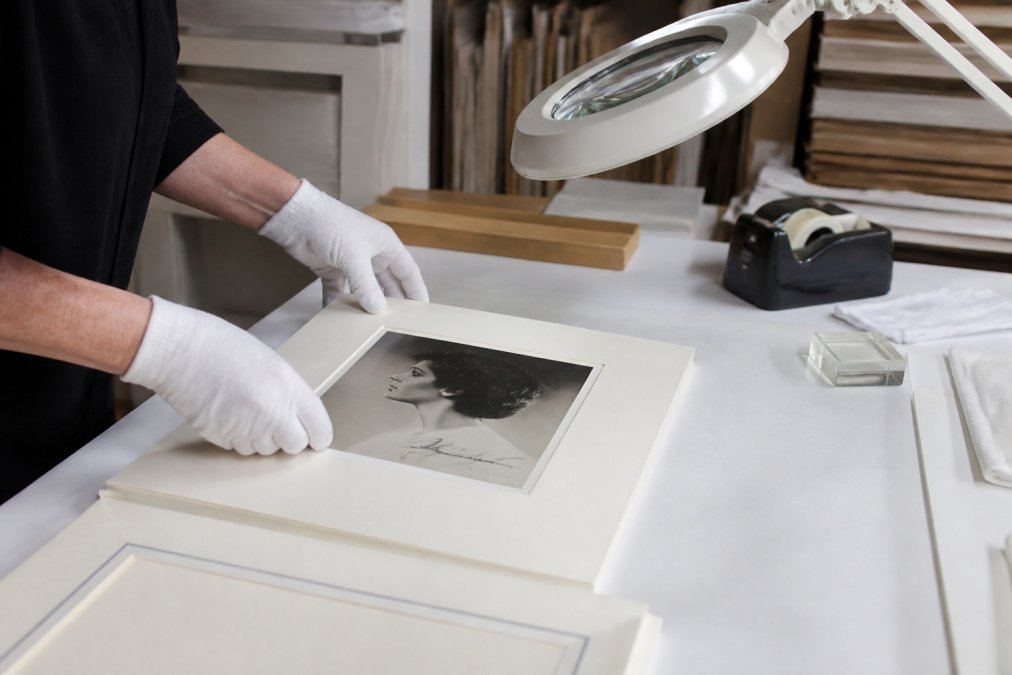
Museum-Quality Framing Standards Explained
Museum-quality framing follows material and handling standards designed to be reversible and chemically inert, so a future conservator can disassemble the frame and remove the artwork without encountering adhesives or degraded materials.
Standards Change With the Medium
A single "museum-quality" label hides the fact that different materials need different treatment. Applying the wrong standard can do as much harm as using cheap materials.
- Photographs and paper documents are the classic case for buffered board and UV glazing, and are most sensitive to light, so rotation and placement matter more than for other media.
- Oil paintings on canvas should not be glazed in most cases. They need airflow and a frame deep enough to keep the surface off the wall; cleaning and varnish work belong with a conservator.
- Textiles and fabric pieces should be stitched to a backing rather than glued, with even support so their own weight does not distort them over time.
- Works on paper with friable media, pastel, charcoal, some pencil, should never be pressed against glazing, because even light contact can smudge the surface. A deep spacer is essential.
Documentation for Insurance and Valuation
Framing and documentation are linked in ways most collectors do not realize until they file a claim. Insurers and appraisers treat a documented, professionally framed piece differently from an undocumented one.
Keep a small file with each framed piece:
- The authenticity paperwork or certificate that came with the item.
- The purchase record or receipt.
- A note of the framing materials used, board type, glazing type, mounting method.
- A photograph of the piece before framing, and one after.
- Any condition notes from a conservator or examiner.
UV Protection for Signed Historical Documents
UV-protective glazing is the single most effective defense against fading for a displayed signed document. Ultraviolet light carries the highest energy in the visible spectrum and drives the chemical reactions that break down ink and paper dyes.

| Glazing Type | UV Filtering | Weight | Best For |
|---|---|---|---|
| UV-filtering glass | High | Heavier | Wall displays, small to medium pieces |
| Acrylic | High | Lighter | Large pieces, shipped frames |
| Museum glass | High plus anti-reflective | Heavier | Glare-prone rooms, detailed signatures |
How to Safely Ship Expensive Collectibles to a Framer
Shipping a valuable signed piece to a framer safely requires rigid packaging, moisture protection, and a shipping method that matches the item's value. Damage in transit is almost always a packaging failure, not a carrier failure.

The sequence matters:
- Place the item in an acid-free sleeve or between two sheets of archival board.
- Sandwich that between two rigid boards cut larger than the item, so corners are protected.
- Wrap the sandwich in a waterproof layer, such as a plastic bag sealed at the edges.
- Fill the outer box so the inner package cannot shift. Movement is what cracks corners.
- Mark the box clearly and use a carrier service with tracking and declared value.
Environmental Impact and Long-Term Maintenance of Archival Frames
Archival framing has a modest but real environmental footprint, and the materials that protect a document also shape how it should be maintained.
- Dust the frame, not the glazing interior. Wipe the frame with a dry or barely damp cloth. Never spray cleaner onto glazing, since liquid can wick behind the frame edge.
- Control humidity. Paper and photographs respond to swings in moisture. Keep framed work away from bathrooms, kitchens, and exterior walls that sweat.
- Limit light exposure. Rotate light-sensitive pieces and use curtains or blinds during peak sun hours.
- Inspect annually. Check the back for dust cover tears, insect activity, and any sign of moisture. Early detection prevents a small problem from reaching the artwork.
- Reframe on a schedule for fragile pieces. Hinge mounts and buffered board have long but finite service lives. Pieces on continuous display benefit from a professional condition check every several years.
Conclusion: Choosing the Right Archival Framing Service for Your Collection
The right archival framing service treats preservation materials as the default, not an upsell. For a signed document with real value, that means acid-free and buffered board, reversible hinge mounting, UV-protective glazing, and a sealed back, confirmed before work begins.
Frequently Asked Questions
What materials are required for true archival framing?
True archival framing uses acid-free, lignin-free mat board and backing, plus UV-protective glazing. Hinges should be made of Japanese paper and wheat starch paste, never pressure-sensitive tape. The frame's rabbet depth must accommodate the mat package without compressing the art. These materials prevent acid migration and fading, preserving your collectible for decades.
How much should I pay for framing a valuable autograph?
Costs vary by size and materials. For a museum-quality frame with UV glazing and acid-free matting, expect to pay several hundred dollars. America's Memories offers ready-to-hang pieces like the Alfred Hitchcock autograph photo at $999.99, which includes professional archival framing. Always prioritize material quality over the lowest price.
How do I safely ship expensive collectibles to a professional framer?
Use a rigid box with at least two inches of padding on all sides. Wrap the item in acid-free tissue, then bubble wrap, and place it in a water-resistant inner bag. Ship fully insured with signature confirmation. For high-value pieces, consider a courier service that handles fine art. America's Memories ships all framed collectibles with full insurance and secure packaging.
What is the difference between acid-free and archival-grade framing materials?
Acid-free means the material has a neutral pH, but archival-grade goes further: it is lignin-free, buffered with calcium carbonate, and tested for longevity. Archival-grade mat board resists yellowing and acid migration that can burn a signature. Look for the term 'conservation-grade' or 'museum-quality' on the product label.
How does UV-protective glass impact the longevity of historical signatures?
UV-protective glazing blocks up to 99% of ultraviolet rays, which cause ink to fade and paper to yellow. For signed historical documents, this is critical because signatures are often in iron gall or felt-tip ink that degrades with light exposure. Even with UV glass, keep framed pieces out of direct sunlight to maximize preservation.