


Table of Contents
- What Forensic Handwriting Analysis Means for Collectors
- How to Spot Fake Celebrity Autographs
- Detecting Forged Signatures on Historical Documents
- What Court-Approved Handwriting Experts Examine
- Forensic Handwriting Analysis for Collectibles: Cost, Turnaround, and Provenance
- When Handwriting Analysis Reports Hold Up in Legal Disputes
- Building a Collection That Stands on Verified Ground
- Frequently Asked Questions
Last Updated: September 23, 2026
What Forensic Handwriting Analysis Means for Collectors
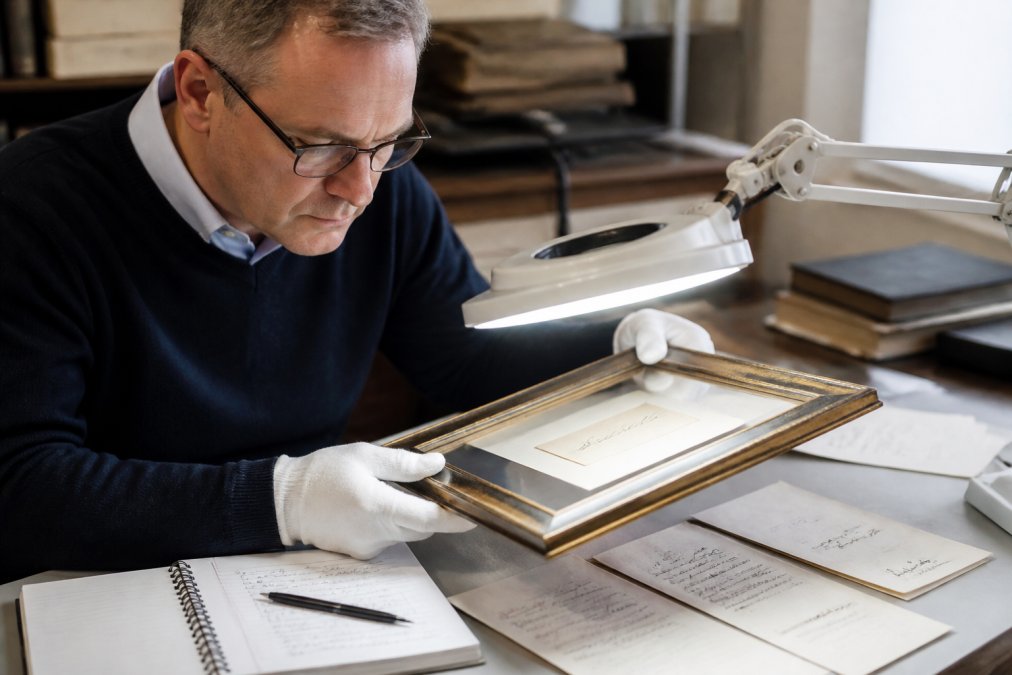
Forensic handwriting analysis for collectibles is the scientific examination of signatures and handwritten documents to determine authenticity, using methods accepted in courts of law. At America's Memories, every autograph is verified this way before it reaches a collector. Unlike the casual opinions traded in online forums, this process relies on measurable characteristics: stroke pressure, pen lifts, slant, and baseline alignment.
Document Examination vs. Graphology: What Actually Holds Up
Document examination and graphology are not the same discipline, and confusing them is the fastest way to buy a forgery. Questioned document examination is a forensic science built on comparative analysis of known writing samples. Graphology, by contrast, claims to read personality from handwriting, a practice with no standing in American courts.
How to Spot Fake Celebrity Autographs
The most reliable way to spot a fake celebrity autograph is to compare it against verified known writing samples rather than trusting a photo or a story. Forged celebrity signatures usually fail on the same handful of details, and collectors who learn those details catch most fakes before money changes hands.
Five Red Flags Collectors Catch Before Buying
- Inconsistent slant or baseline across a signature that should have been written in one motion.
- Slow, drawn strokes visible as shaky lines, a sign of simulated forgery rather than natural writing.
- No provenance documentation, just a verbal claim of where the item came from.
- A price far below the market for that signer, which usually signals a reproduction or outright counterfeit.
- A certificate from an unknown "examiner" with no credentials, no methodology, and no contactable record.
A common mistake is treating a certificate of authenticity as proof. Anyone can print one. What matters is who signed it and whether that examiner is board-certified and court-approved.
Detecting Forged Signatures on Historical Documents
Detecting forged signatures on historical documents requires attention to the material as much as the writing. Ink analysis and paper analysis can expose an item signed decades after the date it claims to carry. A signature applied in 2020 to paper dated 1965 rarely survives close inspection of ink absorption and aging.
What Court-Approved Handwriting Experts Examine
A court-approved handwriting expert examines class characteristics and individualizing characteristics together, then states a conclusion with a confidence level. The work follows a documented scientific methodology rather than a single glance.
| What Examiners Check | Why It Matters | Red Flag If... |
|---|---|---|
| Stroke pressure | Hard to imitate naturally | Lines look drawn or shaky |
| Pen lift | Reveals writing rhythm | Signature breaks mid-stroke |
| Slant and baseline | Consistent in genuine writing | Slant shifts within one signature |
| Ink and paper | Dates the material | Ink sits on top of aged paper |
| Provenance | Ties item to a source | No documented history |
Forensic Handwriting Analysis for Collectibles: Cost, Turnaround, and Provenance
Cost and turnaround for forensic handwriting analysis vary with the item, the number of exemplars required, and whether a formal report is needed. Collectors should expect to pay more for historical pieces that demand extensive comparative analysis, and less for a straightforward modern signature. Turnaround commonly runs from days to a few weeks depending on the examiner's workload.
What Drives the Cost of an Examination
Three variables move the number more than anything else:
- Exemplar availability. If the signer left a deep, well-documented body of writing, think a prolific author or a long-serving public figure, an examiner can build a comparison set quickly. If the signer was reclusive or left few verified samples, the examiner may need to source exemplars from archives, auction records, or institutional collections, and that research time is billable.
- Item condition and material. A clean ink signature on period paper is faster to assess than a faded pencil notation, a signature under glass with glare, or an item where ink and paper must be dated separately. Multi-material examinations (ink analysis plus paper analysis plus handwriting comparison) cost more than a handwriting comparison alone.
- Report format. A verbal opinion is the least expensive deliverable. A written report with photographs, a stated confidence level, and the examiner's reasoning costs more. A report prepared to withstand courtroom scrutiny, documented methodology, chain-of-custody notation, and a signed statement of qualifications, costs more still.
A common pattern is that collectors underbudget the exemplar research and overbudget the handwriting comparison itself. The comparison is often the shorter part of the job.
Turnaround Expectations
Turnaround is driven by examiner workload and by how hard exemplars are to obtain. A modern celebrity signature with abundant verified samples may move quickly. A historical document from a signer with sparse surviving writing can take considerably longer, because the examiner may need to request access to institutional holdings or wait on auction records. Collectors on a deadline, an auction closing, a gift date, should raise that constraint at the outset rather than after the examination begins.
Provenance Documentation: The Piece Most Buyers Undervalue
Here is how the two systems should work together:
- The certificate of authenticity (COA) is not the analysis. A COA is a summary document. The analysis is the underlying comparison: which exemplars were used, what characteristics were examined, and what conclusion was reached. A COA without an accessible analysis behind it is a claim, not evidence.
- Chain of custody should be written down, not remembered. Every transfer, dealer to dealer, auction house to buyer, estate to heir, should be documented with dates and names. Gaps in the chain are where forgeries hide.
- Auction records are provenance. Prior sale listings, catalog descriptions, and hammer results create a paper trail that an examiner can cross-reference. A piece that has appeared in reputable auctions is easier to authenticate than one that surfaced without history.
- The report should travel with the item. When a collector resells, the buyer will want the same documentation the original buyer received. A report that stays in a drawer loses value; a report that stays with the piece compounds it.
America's Memories provides a lifetime authenticity guarantee backed by board-certified, court-approved examiners, and customers can request the underlying analysis rather than accept a vague assurance. Pieces such as a Diana autograph or a Dr. Martin Luther King Jr. autograph arrive with that verification and museum-quality archival framing.


When Handwriting Analysis Reports Hold Up in Legal Disputes
Handwriting analysis reports hold up in legal disputes when the examiner's credentials, methodology, and documentation meet the standard for expert testimony. A report is only as strong as the chain behind it: who examined the item, what exemplars were used, and how the conclusion was reached.
The Admissibility Framework Collectors Should Understand
Courts do not admit expert testimony just because someone claims expertise. Under the federal rules governing expert testimony, a judge acts as gatekeeper and weighs several factors: whether the examiner's method can be and has been tested, whether it has been subjected to peer review, whether it has a known or potential error rate, whether standards and controls exist, and whether the method is generally accepted in the relevant field.
What a Court-Ready Report Contains
A report built to survive legal scrutiny typically includes:
- The examiner's qualifications, including board certification and prior testimony experience.
- A description of the questioned item and its condition, with photographs.
- A list of the known exemplars used, with their sources and dates.
- The characteristics examined, stroke pressure, pen lift, slant, baseline alignment, letter formation, and how the questioned item compared.
- A stated conclusion with a confidence level, rather than a simple yes or no.
- A chain-of-custody notation, showing how the item moved from owner to examiner and back.
A report missing any of these is weaker than it looks. The Federal Rules of Evidence on expert testimony outline how courts weigh this kind of evidence, and the National Institute of Standards and Technology forensic science guidance shapes how examiners document their findings.
Why This Matters to Collectors Who Never Sue
Most collectors will never set foot in a courtroom. That does not make the legal standard irrelevant. A report that could survive legal scrutiny is a report that protects an investment, because it answers the questions a future buyer, insurer, or estate appraiser will ask. When a collection changes hands, through sale, inheritance, or insurance claim, the documentation is what carries the value forward.
The Practical Test Before You Buy
Ask three questions of any seller or examiner:
- Who examined the item, and what are their credentials? Board certification and a record of court acceptance are the benchmarks.
- Can I see the analysis, not just the certificate? The report should name exemplars and describe the comparison.
- Does the documentation travel with the item? If the report stays behind, the next buyer starts from zero.
A report that passes those three questions is one that holds up, in court, at resale, and everywhere in between.
Building a Collection That Stands on Verified Ground
Building a collection that holds its value starts with verification, not volume. Collectors who insist on court-approved forensic handwriting examination, documented provenance, and archival preservation avoid the two costly mistakes that sink most collections: buying on price and trusting an unverified certificate.
Frequently Asked Questions
How much does a forensic handwriting analysis cost?
Fees vary by examiner and the scope of the work. A basic signature comparison on a single item typically runs a few hundred dollars, while full reports with courtroom-ready documentation cost more. Some authenticators bundle the analysis into the price of the piece, as America's Memories does with its forensically verified autographs. Always ask what the fee covers: examination only, or a written report you can use later.
How do forensic experts identify forged signatures on historical documents?
Examiners compare the questioned signature against known writing samples, called exemplars, looking at stroke pressure, pen lifts, slant, and baseline alignment. They also check ink and paper for signs of later addition, and review provenance and chain of custody. A simulated forgery often looks too smooth or too slow, while a traced signature shows hesitation marks that a genuine, fluid signature would not have.
What is the difference between a professional autograph authenticator and a forensic document examiner?
An autograph authenticator usually focuses on celebrity and historical signatures for the collectibles market, often relying on reference files and database hits. A forensic document examiner is trained in questioned document examination and can testify as an expert witness in court. For high-value pieces, a court-approved examiner's report carries more weight if a dispute ever arises over authenticity.
Are forensic handwriting analysis reports admissible in legal disputes regarding collectibles?
Reports from qualified examiners are often admitted when the examiner can be established as an expert witness and the methods follow accepted forensic science standards. Admissibility depends on the court and how the analysis was documented. A report that records known writing samples, individualizing characteristics, and chain of custody is far stronger than a simple opinion letter.
Can I request to see the handwriting analysis report before I buy?
Reputable sellers provide documentation on request. America's Memories backs each piece with a lifetime authenticity guarantee from board-certified examiners, and the free advisory service can walk you through the verification behind a specific item. If a seller refuses to share any analysis or provenance details, treat that as a red flag and look elsewhere.
How does ink and paper age analysis complement handwriting examination?
Handwriting analysis confirms whether the strokes match a known signer. Ink and paper analysis checks whether the materials fit the date claimed. If a signature sits on paper manufactured decades after the signer died, the piece is counterfeit no matter how convincing the handwriting looks. Together, the two methods close gaps that either one alone would miss.