


Table of Contents
- What You'll Need Before You Start Inspecting
- Step 1: Examine the Signature's Line Quality and Flow
- Step 2: Identify Common Signs of Autograph Forgery
- Step 3: Analyze Ink Flow and Pen Pressure
- Step 4: Use Magnification and UV Light Testing
- Step 5: Check Provenance and the COA for Autographs Meaning
- Step 6: Compare with Exemplars and Spot Modern Forgery Tech
- Step 7: Red Flags in Pricing and Seller Reputation
- Frequently Asked Questions
Last Updated: September 16, 2026
What You'll Need Before You Start Inspecting
Spotting fake celebrity autographs starts with the right tools and a patient eye. At America's Memories, we've spent over 40 years handling forensically verified memorabilia, and the difference between a genuine signature and a skilled forgery comes down to small physical details.
Authentication is a physical discipline, not a gut feeling, so gather a few basics first.
Basic Tools for Visual Inspection
You don't need a laboratory to begin. A practical inspection kit includes:
- A jeweler's loupe or a magnifier in the 10x to 20x range
- A small UV flashlight for checking paper and ink reactions
- A clean, well-lit workspace with a neutral background
- Reference images of the signer's known signatures, called exemplars
A common mistake is relying on phone camera zoom instead of real magnification.
Step 1: Examine the Signature's Line Quality and Flow
The fastest way to catch a fake is to study how the line moves. Real signatures flow with natural speed and rhythm from years of repetition.
Shaky Lines and Hesitation Marks
A forger copying slowly produces shaky lines and hesitation marks, tiny pauses where the pen stopped, lifted, or changed direction mid-stroke. Genuine signatures rarely show this.
Look for:
- Wobbly, uneven strokes that suggest the writer was tracing
- Breaks in the middle of a letter where a real signature would flow through
- Inconsistent speed, with some strokes fast and others painfully slow
Start-Stop Marks and Ink Blobs
Where a pen pauses, ink pools. Start-stop marks and ink blobs appear where a forger lifted the pen to reposition; authentic signatures show clean entry and exit points.
Step 2: Identify Common Signs of Autograph Forgery
Knowing the common signs of autograph forgery saves you from expensive mistakes. Most fakes fall into a handful of recognizable categories.
Pre-Printed, Facsimile, and Stamped Signatures
A pre-printed signature is part of the original printing, a facsimile is a mass-produced reproduction, and a stamped signature is applied with a rubber or metal stamp. All three fool casual buyers.
Identical Signatures and the Carbon Copy Effect
No one signs their name exactly the same way twice. If two pieces match line for line, one is a copy, the carbon copy effect, one of the clearest red flags in authentication.
Step 3: Analyze Ink Flow and Pen Pressure
Ink flow and pen pressure reveal how the signature was made. A genuine autograph shows natural variation: thicker lines where the signer pressed harder, thinner lines on fast strokes, and a consistent taper at the end of a stroke.
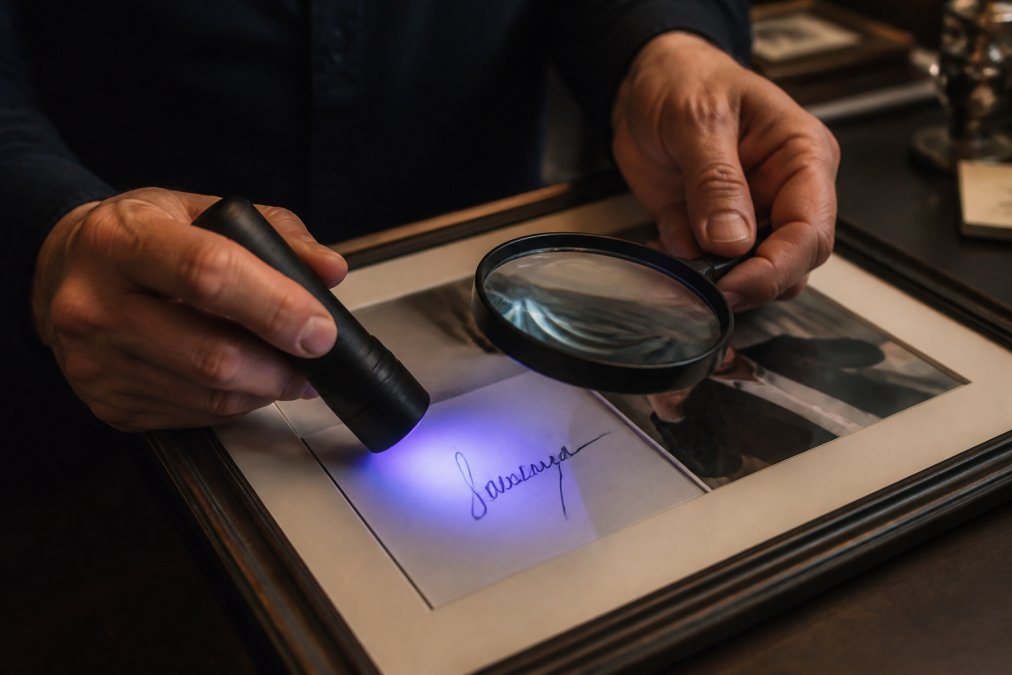
Step 4: Use Magnification and UV Light Testing
Magnification and UV light testing turn guesswork into evidence. Under a 10x loupe you can see individual ink strokes, paper fibers, and whether ink sits on top of the paper or soaks in.
Step 5: Check Provenance and the COA for Autographs Meaning
Provenance is the documented history of an item, and it matters as much as the signature itself. A COA for autographs, a certificate of authenticity, should name the examiner, describe the item, state the date and method of examination, and carry a unique identifier traceable to the issuer.
In-House COAs vs. Third-Party Authentication
There are two broad categories of documentation, and they are not equal:
-
Seller-issued (in-house) COAs. The dealer who sold you the item also wrote the certificate. These can be legitimate, but they are self-graded. If the seller goes out of business, the guarantee often goes with them.
-
Third-party authentication. An independent examiner or authentication service that has no financial stake in the sale examines the item and issues an opinion. This is the standard the serious side of the market runs on.
-
The full name of the examiner or the authentication company, not just a logo
-
A unique certificate or tracking number
-
A description of the item specific enough to match it (medium, size, inscription, date)
-
The date of examination and the method used (visual, microscopic, UV, exemplar comparison)
-
A stated opinion, "authentic," "likely authentic," or "unable to authenticate", rather than vague praise
How to Verify a Digital COA
Most modern authentication companies issue digital certificates, and this is where collectors get tripped up. A PDF with a seal image is not verification; real verification means the certificate can be looked up in the issuer's own database.
A practical workflow:
- Go to the authentication company's website directly, type the domain yourself rather than clicking a link in the seller's listing.
- Enter the certificate number into the company's verification tool.
- Confirm the item description, signer, and date on the database record match the physical piece in front of you.
- Check that the record has not been flagged as revoked, altered, or reported stolen.
What Provenance Should Actually Tell You
Documentation should tell a story: where the item came from, how it was obtained, and who verified it. Strong provenance chains include a signing event date and location, a private signing receipt, a signing photo, a prior auction record, or a letter from a verifiable previous owner.
Step 6: Compare with Exemplars and Spot Modern Forgery Tech
Comparison with exemplars is the standard professional method, and the step most collectors skip because they don't know where to get reliable references. An exemplar is a known-genuine signature from the same person, ideally from a similar era. Signatures change with age, health, and even the pen a person habitually used, so a 1970s signature may look quite different from one signed in the 1990s.
How to Source and Use Exemplars
Good exemplars come from sources where authenticity is not in question:
-
Government or institutional records with a verified signature (signed contracts, official documents, published correspondence)
-
Auction house archives for items that sold with independent authentication
-
Reference books and published signature guides from established autograph dealers
-
Museum or archive collections that publish high-resolution images
-
Slant and baseline. Does the signature lean at the same angle, and does it sit on the same imaginary line?
-
Letter proportions. Is the first initial taller or shorter than the exemplar? Are the loops the same width?
-
Connective strokes. How does the signer move from one letter to the next? Fast, connected writers leave different trails than deliberate ones.
-
Terminal flourish. The final stroke is often the most habitual and the hardest to fake.
-
Crossbars and dots. The angle and length of a "t" crossbar or the placement of an "i" dot is a fingerprint-level detail.
Autopens, Laser Printers, and AI-Assisted Forgeries
This is why digital authentication records and physical inspection now work together. A verifiable certificate number plus hands-on examination of ink, pressure, and line behavior catches what either method alone would miss, the combination separates a confident purchase from a gamble.
Step 7: Red Flags in Pricing and Seller Reputation
Pricing that seems too good is the oldest warning sign in the market. Celebrity autographs with real market value rarely sell at a steep discount, so if a seller offers a piece far below comparable authenticated items, ask why.
| Red Flag | What It Signals | What to Do |
|---|---|---|
| Price far below market | Likely forgery or misrepresentation | Compare against authenticated sales |
| No named examiner on COA | Certificate carries little weight | Request the full report |
| Identical signatures across items | Mechanical copy or print | Walk away |
| Flat back, no pen groove | Printed, stamped, or autopen | Verify with magnification |
| Vague or missing provenance | Unknown origin | Ask for documented history |
Frequently Asked Questions
How do you know if a famous autograph is real or not?
Authenticating a famous autograph requires examining line quality, ink flow, and provenance. Look for natural hesitation marks and consistent pen pressure. Fake celebrity autographs often show shaky lines or start-stop marks. A certificate of authenticity (COA) from a reputable third-party authentication service adds confidence. For high-value pieces, professional forensic examination is recommended.
How can you tell a fake signature?
Common signs of autograph forgery include pre-printed or stamped signatures, identical signatures across multiple items, and ink that appears too uniform. Use magnification to check for ink blobs or faded ink. UV light testing can reveal modern forgery techniques. Compare the signature with known exemplars. If the price seems too low, it's likely a scam.
Is faking an autograph illegal?
Yes, faking an autograph is illegal under U.S. law. It can constitute fraud, counterfeiting, or violation of state and federal statutes. The FBI and FTC have pursued cases involving forged memorabilia. Penalties may include fines and imprisonment. Collectors should report suspected forgeries to authorities and rely on autograph authentication services to avoid legal and financial risks.
What is a COA for autographs meaning?
A COA (Certificate of Authenticity) is a document that vouches for an item's authenticity. For autographs, it should include details like the signer's name, date, and authentication method. However, not all COAs are equal. A COA from a reputable third-party authentication service, such as one with board-certified examiners, carries more weight. Always verify the COA's issuer and ensure it matches the item.