


Table of Contents
- What Provenance Means for Rare Autographs
- How to Authenticate an Autograph Using Provenance
- Building an Autograph Chain of Ownership
- The Role of Autograph Certificate of Authenticity
- Autograph Documentation: What Collectors Need to Preserve
- Provenance Gaps and Red Flags in Autograph Collecting
- How Provenance Protects Your Investment and Legal Rights
- Frequently Asked Questions
Last Updated: October 13, 2026
What Provenance Means for Rare Autographs
Provenance is the documented ownership history of a collectible, tracing it from its original source through every owner to today.
When collectors ask why provenance matters for rare autographs, they're really asking two questions: Can I trust this signature is genuine?
The ownership history tells a story: where the piece came from, who held it, and how it was preserved. A Lincoln-signed letter gifted to a family member in 1880, passed through generations, sold at auction in 1995, then acquired by a museum, carries a trail of evidence, each transfer a checkpoint, each owner a witness to authenticity.

America's Memories has spent over 40 years building expertise in evaluating this documentation. Provenance is not authentication, but it's the foundation that makes authentication meaningful.
How to Authenticate an Autograph Using Provenance
Provenance strengthens authentication by providing context.
Start by gathering documentation: purchase receipts, auction house catalogs, insurance appraisals, and any letters or certificates that traveled with the piece.
Then look for gaps.
Finally, cross-reference provenance with forensic analysis.
America's Memories uses this approach with every piece: court-approved forensic examiners review both the signature and the ownership records to build a complete picture.
Building an Autograph Chain of Ownership
A chain of ownership is a documented record of every person or institution that has held the autograph.
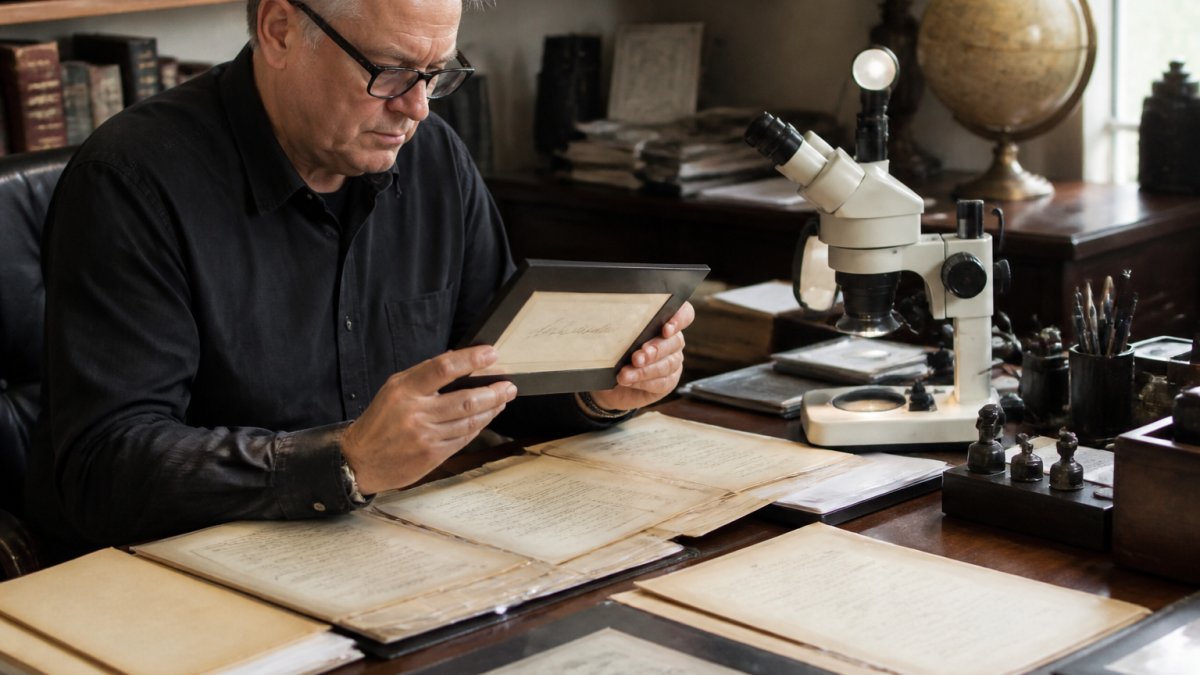
Start by identifying the original source: who created the autograph, in what format (letter, signed photograph, check, document), and when.
Next, trace the first transfer, did the recipient keep, gift, or sell it? The earlier you can document ownership, the stronger your chain. A Gandhi handwritten letter that stayed in the recipient's family for decades carries more weight than one that appeared suddenly in a dealer's catalog.

Document each subsequent transfer with supporting evidence:
- Purchase receipts from dealers or auction houses
- Auction catalogs that describe and photograph the piece
- Insurance appraisals with detailed condition notes
The more documentation you gather, the more complete your chain becomes.
When building your own chain, preserve every receipt and document, photograph the autograph under consistent lighting, and record where, when, and for how much you purchased it.
The Role of Autograph Certificate of Authenticity
An autograph certificate of authenticity (COA) is a formal document stating that an expert examined the signature and found it genuine.
A strong COA should include several key elements:
- Expert credentials: Who examined the piece? What are their qualifications? Are they board-certified? Have they testified in court?
- Date of examination: When was the analysis performed? A COA issued decades ago may not reflect the current state of the item.
- Detailed findings: What specific features of the signature were analyzed? What pen pressure, ink, and letter formation characteristics support authenticity? A COA that says only "examined and found genuine" tells you almost nothing.
A certificate from a court-approved forensic handwriting examiner carries more weight than one from a dealer or general appraiser.
A COA is not the same as provenance: a COA confirms the signature is real, while provenance confirms the item's history is legitimate.
How to Evaluate a COA Before You Rely on It
Treat a COA as one piece of evidence, not a verdict:
- Identify the issuer. Search the examiner's name for professional affiliations, published references, prior court testimony, or a track record with the signer's era and handwriting style. A 19th-century correspondence specialist fits a Lincoln letter better than a generalist.
- Check the date against the item's history. A COA dated before the current owner acquired the piece, or one that references a prior owner not in the provenance chain, deserves a follow-up question.
- Read the findings for specificity. Look for named features: stroke direction, pen lifts, baseline, ink type, paper stock. Vague language ("consistent with known examples") is weaker than a described comparison to dated reference exemplars.
- Confirm the COA references the provenance. The best certificates describe the ownership history they reviewed, not just the signature.
- Look for a stated scope and limitations. A COA that claims certainty on a heavily faded or trimmed document is a red flag; a COA that flags the limitation is a sign of a careful examiner.
- Verify the certificate itself. Contact the issuing examiner or firm through an independent channel, not the phone number on the COA, to confirm it is genuine and still stands.
COA Red Flags
- No examiner name, only a company logo.
- No examination date, or a date that conflicts with the item's documented history.
- Photocopied or generic language that could apply to any signature.
When evaluating an autograph certificate of authenticity, ask: Who issued it? How recent is it? Does it reference the provenance? Has the expert's work held up under scrutiny? These questions reveal whether the certificate adds real credibility, or just paper.
Autograph Documentation: What Collectors Need to Preserve
Documentation is the physical evidence of provenance. Without it, you have a story with no proof; with it, a defensible investment.
What should you preserve?
- Original receipts and invoices from your purchase
- Auction house catalogs if you bought at auction
- Certificates of authenticity from any previous experts
Store these documents safely: acid-free folders and archival storage, a safe deposit box or home safe for originals, and digital copies in a secure cloud backup.
If you sell later, pass all documentation to the new owner.
America's Memories frames autographs using archival-quality, acid-free materials, so preservation begins the moment you acquire the piece.
Provenance Gaps and Red Flags in Autograph Collecting
Gaps in provenance happen. An autograph might sit in a private collection for 30 years with no public record, or pass through an estate sale with incomplete records.
Red flags to watch for:
- Sudden appearance: The autograph has no documented history before a dealer acquired it recently. Where did it come from?
- Missing decades: You have records from 1920 to 1950, then nothing until 2000. What happened during those 50 years?
- Vague descriptions: Previous documentation describes the piece as "a signed letter" without details about content, condition, or provenance.
When you encounter gaps, ask questions.
Incomplete provenance lowers value. A rare autograph with a 20-year documented history might sell for half the price of an identical piece with a 100-year history, because the risk is higher, you're betting on forensic analysis alone, without the supporting evidence provenance provides.
How Provenance Protects Your Investment and Legal Rights
Provenance protects you in three ways: it supports authenticity claims, establishes legal ownership, and preserves resale value.
Authenticity protection: A strong provenance chain makes it harder to challenge the piece's authenticity later.
Legal ownership: Provenance establishes that you own the piece legitimately. If an autograph was stolen, lost, or obtained through fraud, that history should appear in the chain.
Resale value: When you sell, provenance is what buyers pay for.
Autograph-Specific Value Factors
Provenance doesn't operate in a vacuum. Its effect on price depends on how it interacts with the rest of the piece:
- Signer significance. A documented chain on a signature from a major historical figure or top-tier entertainment name moves value more than the same chain on a lesser-known signer, because the buyer pool is larger and the forgery incentive higher.
- Rarity of the format. A signed letter with dated content is harder to fabricate convincingly than a bare signature on a card, so provenance carries more weight when the item is complex.
- Condition. Provenance documenting careful storage, archival framing, controlled environment, no restoration, supports a higher grade; provenance revealing past damage or trimming does the opposite.
- Marketability of the story. A chain with a named recipient, dated event, or public exhibition is more marketable than an anonymous "private collection" entry, even if both are equally verifiable.
The Limits of Provenance as Proof
A documented ownership chain supports an authenticity assessment but does not independently prove a signature is genuine. A forger can fabricate a plausible ownership story, and an honest seller can inherit a piece with a story that turns out wrong. Provenance is corroborating evidence, not a verdict. The strongest files combine documented ownership, dated inscriptions or correspondence, and independent forensic review under a microscope or forensic-grade magnification equipment.
What to Do When Provenance Is Incomplete
Gaps are common, especially for autographs that spent decades in private hands. A practical response:
- Preserve what you have. Don't discard partial records, old envelopes, or handwritten notes, even fragments can anchor a date or name later.
- Seek independent review. Have a board-certified forensic examiner assess the signature and note where physical evidence is consistent or inconsistent with the claimed era.
- Document the gap explicitly. Write down what is unknown, when the gap begins and ends, and what you tried to verify. Buyers and insurers trust a seller who names the gap more than one who glosses over it.
- Adjust your offer and your insurance. Incomplete provenance should lower your offer price and may affect how an insurer values the piece. Ask your insurer how they treat gaps.
- Keep looking. Auction house archives, dealer records, estate inventories, and institutional loan files sometimes surface years later. A gap today isn't necessarily a gap forever.
Consider this scenario: You purchase a rare autograph for $5,000, display it for five years, then decide to sell. If you have receipts, insurance appraisals, condition reports, and photographs, the buyer feels confident and might offer $5,500 or $6,000. With nothing but the framed signature, the buyer worries about authenticity and condition, and offers $3,000 or walks away.
The difference is provenance, and the discipline to document it from day one.
Frequently Asked Questions
What documents help establish an autograph's provenance?
Key documents include original purchase receipts, sale records from auction houses, loan records from exhibitions, donation papers, and previous owner correspondence. Photographs of the autograph from different time periods, exhibition catalogs, and insurance appraisals also strengthen provenance. A forensic certificate of authenticity from a board-certified examiner serves as critical supporting evidence. The more complete your documentation chain, the stronger your ownership history and the greater confidence collectors and institutions have in the piece.
Can provenance alone prove that an autograph is authentic?
No. Provenance documents ownership history but does not confirm a signature is genuine. A well-documented ownership chain combined with forensic handwriting analysis provides the strongest verification. Provenance supports authenticity assessment by showing the item has been studied, displayed, or authenticated by credible institutions over time. However, authentication requires scientific examination using forensic-grade magnification equipment and expert analysis of the writing characteristics, ink composition, and paper age. Provenance and forensic verification work together to establish both authenticity and value.
How should collectors document an autograph's ownership history?
Start by gathering all existing records: original purchase documentation, receipts, auction catalogs, insurance appraisals, and correspondence with previous owners. Create a written timeline of ownership with names, dates, and circumstances of each transfer. Photograph the autograph from multiple angles and store images digitally with metadata. Keep a detailed inventory record including the piece's condition, any conservation work performed, and exhibition history. Store all documents in acid-free archival folders. When you acquire a piece, request any available provenance documentation from the seller and maintain it alongside your own records. This systematic approach creates a comprehensive chain of custody that protects your investment and simplifies future sales or estate planning.
Why does provenance affect the market value of rare autographs?
Provenance directly impacts value because collectors and institutions pay more for pieces with documented ownership histories. A rare autograph with a clear, unbroken chain of custody from a known source commands significantly higher prices than an identical piece with gaps or unknown origins. Institutional ownership, exhibition history, and forensic authentication all increase buyer confidence and resale potential. Pieces lacking provenance face skepticism about authenticity and legal ownership, reducing demand and market value. Collectors view strong provenance as insurance against purchasing counterfeits or stolen items, making well-documented autographs more liquid and valuable investments.