


Table of Contents
- What Is a Forensic Autograph Authentication Report?
- Why Forensic Autograph Authentication Reports Matter
- How Forensic Handwriting Analysis Autograph Examination Works
- Certificate of Authenticity for Autographs Versus Forensic Reports
- Autograph Authentication Examples: Genuine Signatures vs. Forgeries
- How Long Does Autograph Authentication Take?
- What to Submit and What Examiners Look For
- Reading and Interpreting Your Forensic Report
- Frequently Asked Questions
Last Updated: October 12, 2026
What Is a Forensic Autograph Authentication Report?
A forensic autograph authentication report is a scientific document that examines whether a signature is genuine or forged. Prepared by court-approved forensic handwriting examiners, it analyzes pen pressure, line quality, letter formation, spacing, and slant, and compares them against known exemplars (reference signatures) from the same person.
The report is both a forensic analysis and a legal document, recording the examiner's methodology, findings, and professional opinion.
America's Memories works with board-certified forensic handwriting examiners to provide these reports for every authenticated piece in its collection.
Why Forensic Autograph Authentication Reports Matter
Collectors and investors depend on forensic autograph authentication reports because they separate genuine signatures from sophisticated forgeries.
The report also protects collectors legally. If a piece is challenged or authenticity must be proven for insurance, the forensic examination provides a documented foundation, and court-approved examiners understand the standards legal proceedings require.
For dealers and auction houses, these reports build buyer confidence, transforming a signature from "the seller says it's real" to "an independent expert verified it using forensic methods."
How Forensic Handwriting Analysis Autograph Examination Works
Forensic handwriting analysis autograph examination follows a structured methodology combining visual inspection, comparative analysis, and specialized imaging. The examiner first documents the questioned autograph through high-resolution photography and notes on its physical condition, paper type, and ink characteristics.
The core of the examination is signature comparison.
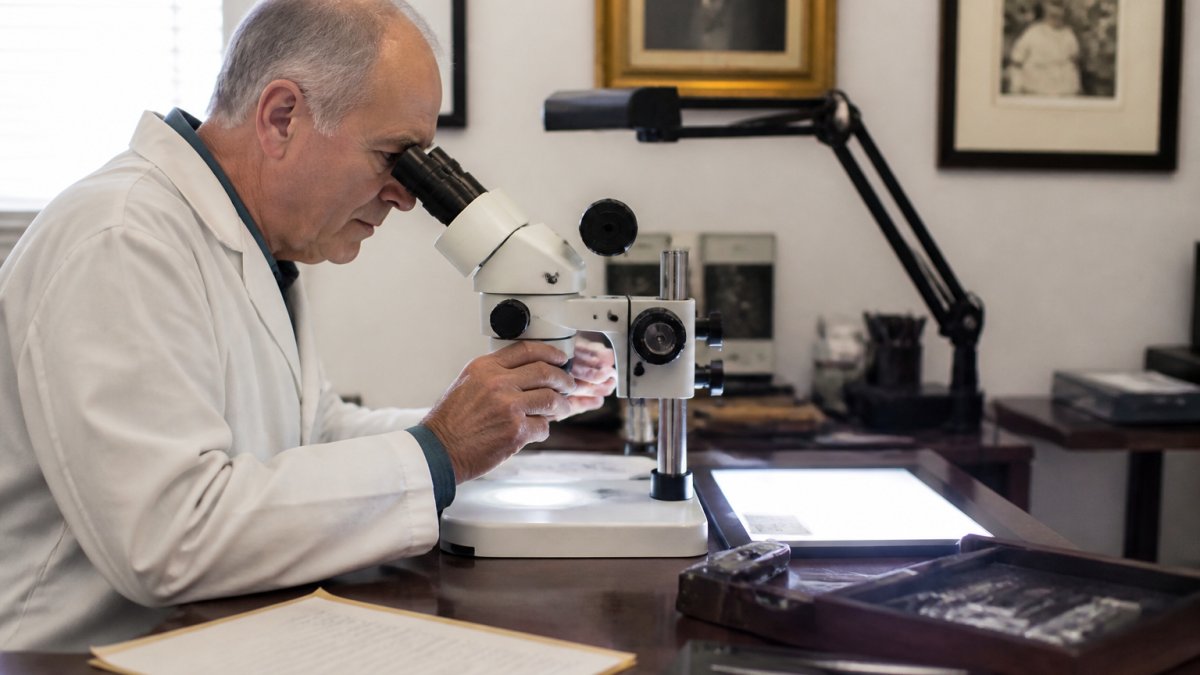
Forensic-grade magnification equipment allows the examiner to inspect microscopic details invisible to the naked eye. Pen pressure variations, ink flow patterns, and the presence of hesitation marks or lifting become visible under magnification.
Signature Comparison and Known Exemplars
The comparison process is where forensic handwriting analysis autograph examination proves its value.
Forged signatures often fail this test: a forger may capture a signature's overall appearance but cannot replicate the unconscious motor patterns that make handwriting unique. Tracing leaves telltale signs, hesitation marks at letter junctions, unnatural pen lifts, and pressure inconsistencies that don't match the original writer's rhythm.
Ink and Writing Characteristics
Ink analysis is a secondary but important component of forensic autograph authentication. The examiner notes ink color, consistency, and flow; an autograph purporting to be from 1920 but showing 1980s ballpoint characteristics raises immediate questions.
Writing characteristics extend beyond ink: baseline consistency, slant angle, letter formation, and pressure distribution. Natural writing pressure creates visible variations in line weight, while a forger working slowly often produces uniform pressure that appears unnatural next to genuine signatures written at normal speed.
Certificate of Authenticity for Autographs Versus Forensic Reports
A certificate of authenticity for autographs and a forensic autograph authentication report are not the same document, though the terms are sometimes used interchangeably.
A certificate of authenticity is typically issued by a dealer, auction house, or seller, stating that the issuer believes the autograph is genuine based on their expertise.
A forensic autograph authentication report, by contrast, is a scientific document prepared by a court-approved examiner, documenting the methodology, findings at each step, and conclusions with stated confidence levels.
For collectors, the forensic report provides stronger protection.
Autograph Authentication Examples: Genuine Signatures vs. Forgeries
Consider a historical document bearing what appears to be a presidential signature.

Forged signatures betray themselves through inconsistency. A forger may replicate letter shapes but miss the natural pressure variations of normal writing; under magnification, hesitation marks appear where the forger paused to study the exemplar.
Another common technique is tracing: placing a genuine signature beneath thin paper and tracing over it.
How Long Does Autograph Authentication Take?
The timeline for forensic autograph authentication varies with case complexity and examiner workload.
More complex cases, historical documents, multiple questioned signatures, or suspected alterations, may take longer, requiring exemplars from archives, ink analysis, or consultation with other specialists.
America's Memories works with examiners experienced in expediting authentication without compromising rigor. The goal is to provide collectors with timely results while maintaining the scientific standards that make the forensic autograph authentication report valuable.
What to Submit and What Examiners Look For
Most authentication pages tell you a report exists; few explain how to build a submission packet that gives an examiner enough to work with. That preparation often determines whether a report comes back decisive or hedged.
The submission packet, item by item
A complete packet typically contains four things:
- The questioned item, in original form whenever possible. A signed letter, cut signature, signed photograph, or signed book carries information a scan cannot: paper texture, ink depth, ink flow, and impression depth are readable under a microscope but flatten out in a photograph.
- High-resolution images as a backup or substitute. When an item is too fragile, too valuable to ship, or held by a third party, examiners work from detailed captures: overall shots plus close-ups of the signature, surrounding text, and any date or inscription.
- Known exemplars, ideally five to ten, spread across the signer's career. A single reference signature is weak evidence; multiple exemplars from different periods show which traits stayed constant and which drifted with age, illness, or a change in writing instrument.
- Provenance and context documents. Receipts, auction records, dealer correspondence, family letters, estate inventories, or a written ownership history. These don't prove authenticity alone but help the examiner judge whether the item's physical characteristics fit its claimed origin.
Choosing exemplars that actually help
Exemplars should come from reliable sources: published works, institutional archives, previously authenticated documents, or signed items with documented chain of ownership. A reference signature from an unverified online listing can contaminate the comparison.
Timing matters as much as source: signatures from 1950, 1965, and 1975 give a clearer picture of how the person's hand evolved. Pair each exemplar with its date when known, and note the writing instrument if visible.
What the examiner actually evaluates
Once the packet is in hand, the examiner works through a consistent checklist: letter formations and proportions, spacing, slant, baseline consistency, pen pressure variation, and stroke rhythm.
The examiner also checks the item against its own story: modern ballpoint ink on a document dated decades earlier, or a late-life signature style on a piece purporting to be from the signer's twenties.
Chain of custody and handling
If the report may be used for an estate dispute, insurance claim, or court, handling matters as much as findings.
A clean chain of custody strengthens the report's evidentiary value; a broken one gives the other side something to attack even when the findings are solid.
Reading and Interpreting Your Forensic Report
A forensic autograph authentication report is not a yes-or-no verdict but a structured argument. Reading it well means following the examiner's reasoning from the questioned item through the exemplars to the conclusion.
The standard sections, in order
Most reports follow a predictable sequence:
- Identification. What was examined and which known exemplars formed the comparison baseline.
- Methodology. The techniques applied, microscopic examination, side-by-side comparison, imaging, or specialized testing, and the standards used.
- Observations. Raw findings: letter formations, pen pressure, line quality, spacing, slant, and anomalies such as hesitation marks, retouching, or tracing artifacts.
- Comparison. How each observed trait lines up with, or departs from, the exemplars.
- Conclusion. The examiner's professional opinion, usually with a confidence qualifier.
- Limitations. What the examination could not determine, and why.
Decoding the conclusion language
Conclusion wording is where most readers go wrong. A few phrases recur, and each carries a different weight:
- "Consistent with", the analysis found no contradictions between the questioned signature and the exemplars. It is supportive, not absolute.
- "Inconsistent with", specific findings contradict the exemplars. This is a stronger statement than a mere failure to match.
- "Highly probable" / "probable", the examiner is signaling a graded confidence level rather than certainty.
- "Cannot be determined", the evidence was insufficient, often because exemplars were thin, the item was degraded, or the writing was too brief to reveal habitual traits.
Reading the findings, not just the verdict
The observations and comparison sections are where the real work lives. A thorough report walks through the examination step by step, naming each trait and how it compared; one that jumps from identification straight to a conclusion deserves scrutiny, regardless of which way it points.
Pay attention to contradictions the examiner flags: a signature whose letter forms match but whose ink behavior doesn't fit the claimed era is a mixed result, and a good report says so rather than smoothing it over.
What the report can and cannot establish
A forensic report speaks to whether a signature was written by the person it purports to be from. It generally cannot, on its own:
- Date an item with precision, unless ink or paper analysis supports a range.
- Prove that a genuine signature was placed on a document at the time the document claims.
- Establish provenance or ownership history.
- Rule out every possible forgery method.
Understanding these limits is not a weakness in the report, it is part of reading it honestly.
Using the report in a dispute, claim, or estate matter
For insurance claims, estate valuations, or court proceedings, the report's value comes from its documentation: methodology, exemplars used, chain of custody, and stated confidence level. A court-approved examiner's report is structured to withstand legal scrutiny, and the limitations section is part of what makes it credible.
Keep the report with the item's provenance file. If the piece is challenged or resold, the report, findings, conclusion, and limitations together, carries the weight.
Collectors working with America's Memories receive pieces backed by forensic autograph authentication reports prepared by board-certified examiners. The report provides the scientific foundation that transforms a signature into a verified, investment-grade collectible, whether the piece is a historical document, a celebrity autograph, or a rare entertainment collectible.
Frequently Asked Questions
What should a forensic autograph authentication report include?
A comprehensive forensic autograph authentication report includes the examiner's credentials and methodology, detailed examination findings on signature characteristics like pen pressure and letter formation, comparison of the questioned signature against known exemplars, analysis of ink and writing materials, assessment of any alterations or tracing, and a clear conclusion stating the examiner's opinion on authenticity with a confidence level. The report should explain the forensic methods used, their capabilities and limitations, and provide supporting evidence such as high-resolution images and reference materials examined.
How do forensic handwriting analysis autograph experts determine if a signature is genuine?
Forensic handwriting analysts examine multiple characteristics of the questioned signature compared against known exemplars from the same individual. They assess pen pressure, baseline consistency, letter formation, spacing, slant, and natural variation in the handwriting. Using forensic-grade magnification equipment, examiners look for signs of tracing, simulation, or alterations that indicate forgery. They also analyze ink composition and characteristics when relevant. The expert then synthesizes these findings into a professional conclusion about whether the signature matches the known authentic writing of the person in question.
How long does autograph authentication take?
Forensic autograph authentication timelines vary depending on the complexity of the case, the number of reference signatures available, and the examiner's current workload. Straightforward cases with clear exemplars may take several weeks, while complex cases involving multiple questioned documents or limited reference material can extend to several months. Court-approved examiners typically prioritize cases with legal or insurance implications. Turnaround times should be discussed with the examiner when commissioning the report, as rush services may be available at additional cost.
What is the difference between a certificate of authenticity for autographs and a forensic report?
A certificate of authenticity for autographs is often a brief statement or visual certification that a signature is believed to be genuine, sometimes issued by dealers or authentication services without detailed forensic analysis. A forensic autograph authentication report, by contrast, is a comprehensive document produced by a qualified handwriting examiner that details the scientific methods used, specific findings on signature characteristics, comparison data, and a professional opinion supported by evidence. Forensic reports carry greater legal weight and are court-approved, making them more reliable for high-value purchases, insurance claims, or estate matters.